Apr 30, 2010

Living Within Limits - Intro (Tragedy of the Commons)

Author: Garrett Hardin

"I teach only two things: the cause of human sorrow and the way to become free of it" -The Buddha

If you are like me, you do not know who Garrett Hardin is.  However, like me, you may have heard of his most famous work: Tragedy of the Commons (1968)

For those unfamiliar with the reference, this was an ecology article, the heart of which can be summed up by a parable.  In the story, there was a piece of pasture land shared among many herdsman, but owned by none.  Each herdsman is free to use as much of the pasture to raise as many animals as his heart so desired.  Hardin then described the 'tragedy' to follow: 

Living within Limits: Ecology, Economics, and Population TaboosIt is to be expected that each herdsman will try to keep as many cattle as possible on the commons. Such an arrangement may work reasonably satisfactorily for centuries because tribal wars, poaching, and disease keep the numbers of both man and beast well below the carrying capacity of the land. Finally, however, comes the day of reckoning, that is, the day when the long-desired goal of social stability becomes a reality. At this point, the inherent logic of the commons remorselessly generates tragedy. 

As a rational being, each herdsman seeks to maximize his gain. Explicitly or implicitly, more or less consciously, he asks, "What is the utility to me of adding one more animal to my herd?" This utility has one negative and one positive component.
  • Negative: the pasture is slightly degraded by each additional animal. - accrued evenly to all herdsman (importantly, the man in question would only accrue a small fraction of actual costs)
  • Positive: the herder receives all of the proceeds from each additional animal
[T]he rational herdsman concludes that the only sensible course for him to pursue is to add another animal to his herd. And another; and another . . . . But this is the conclusion reached by each and every rational herdsman sharing a commons. Therein is the tragedy. Each man is locked into a system that compels him to increase his herd without limit -- in a world that is limited.
This conclusion has been played out not only in agriculture, but some non-environmental areas of study as well.  Consider the following example.

FDIC Insurance was created as a result of bank-runs during the Depression.  The U.S. government (rightly) surmised that by giving an explicit Federal-Guarantee on the funds of depositors at banks, the probability of bank panic would decrease.

This theory played out for a long time, exactly as the federal government believed.  However, some criticized the creation of the FDIC because it essentially created a 'common pasture' for the banks and depositors.  The depositors no longer had an incentive to analyze the credit-worthiness of their local credit unions, thrifts, and banks - all deposits became identical (backed by the FDIC).  The banks no longer had to worry about depositors withdrawing money if the bank was being 'too risky' - so indeed they began buying up riskier assets and giving out riskier loans.  Quite likely, the FDIC played a large role in creating the 'Too Big to Fail' problem we now face, because there essentially could not be a failure - when banks succeed, more profits; when they fail, FDIC pays... Tragedy
(Tragedy did ensue... some believe the S&L crisis was caused by FDIC insurance, and perhaps even the current recession, which originated from excessive bank lending/risk-taknig)
But I digress.  Living Within Limits carries on the discussion began in Tragedy of the Commons, and Hardin makes one more plea to the rest of us for constraint (for our own sakes).  In the tradition of thermodynamics, here is something to leave you with in this introduction/rant:

Hardin's Second Law of Human Ecology:
There's no away to throw to.

Apr 27, 2010

Evolution is Not Optimal Solution?

While reading about Evolutionarily Stable Strategies (ESS), I came across an example... and then I got to thinking...

Background:  One species with 2 members, with differing traits
(Points corresponding to action performed in parenthesis)
  1. Hawks - behave aggressively
    • If opponent runs, eat food (+50)
    • If opponent fights back, they will fight to near-death
      • 1 always wins (+50), 1 always loses (-100)
  2. Doves - behave submissively
    • If attacked, will run away (+0)
    • If not attacked, will make threatening display
      • 1 always wins (+40), 1 always loses (-10)

Scenario 1 - Doves Only
  • Average of 15 points per confrontation to each member
  • However, susceptible to Hawk mutation
    • One Hawk will receive 50 points per encounter
    • More food will result in increased Hawk population

Scenario 2 - Hawks Only
  • What if Hawks take over?
  • Average of -25 points per confrontation to each member (DISASTER)
  • Population would go extinct (Fighting is costlier than the food)

Scenario 3 - Equilibrium
  • 5:7 Dove to Hawk ratio
  • Stable population balance
  • Average of 6.25 points per confrontation to each member

Why is this so interesting?

The real world is probably closer to Scenario 3 than Scenario 1.  However, Scenario 1 is BY FAR, the better world to live in (15 points vs 6.25 points).  Evolution led us to where we are, but quite likely there are better ways to improve life in our communities through concerted efforts to 1) cooperate, and 2) resist the urge to act in our own self-interest at the expense of others - Love Thy Neighbor

Note:  if the doves decide to make no threatening display, the expected value (per member, per encounter) would increase from 15 to 20 - Ninth Commandment (You shall not bear false witness against your neighbor)


Apr 26, 2010

Deep Simplicity - Chapter 7

Life Beyond
  • Jim Lovelock - developed idea that living and nonliving components of terrestrial environemnt interact in network that maintains conditions suitable for life on Earth (Gaia)
    • Suggest that the best way to search for life was 'entropy reduction'
      • Life creates islands of order in the midst of chaos
      • Search for non-equilibrium gases in atmosphere
      • Search for 1/f noise (information giving)
  •  Gaia - idea of Earth as a self-regulating system
    • Gaia: A New Look at Life on Earth
    • NOT synonymous with idea of Gaia as God or Mother Earth
    • Simply states idea of living & nonliving processes working together in self-organizing matter to create and preserve order
    • Evolutionarily speaking, change in biological species not only affect other species, but the entire planetary system
  • Daisyworld (Faint Young Sun Paradox)
    • Paradox - During earlier periods, the Sun existed at only 70% of present heat levels.  Around 4.5B years ago, the Sun settled down to present temperature.  However liquid water (and life) existed prior to the rise in temperature, and persisted throughout the ordeal.  How??
    • Life manipulated the physical environment for its own benefit
    • Simulation - Phase 1
      • Initially - Sun is weak, surface is barren and gray
      • As Sun increases, black daisies grow and thrive
        • Absorb radiant energy
      • As heat increases, white daisies also grow
      • Two population eventually reaches equilibirium and work together to regulate surface temperature (black/white surface to absorbe/reflect light)
    • Simulation - Phase 2
      • If temperature increases, white daisies gain advantage
        • Increase in white daisies will cause decrease in temperature
        • Equilibrium is restored
        • Vice versa
    • Simulation - Phase 3
      • Temperature increases to the point where even white daisies can no longer survive
      • Surface becomes barren
    • Key - Feedback allows life to manipulate the larger environment
  • Real world examples of Daisyworld-type scenarios exist
    • Dimethyl sulfide (DMS)
    • Microscopic life in oceans regulate Earth's climate
    • If algae become active, cloud cover increases
    • Less sunlight available for photosynthesis
    • Biological activity declines

Deep Simplicity - Chapter 6

Facts of Life

Darwinian Evolution
  • Offspring resemble parents - traits passed to next generation
  • Imperfect process - variations exist in each generation
  • More individuals born than survive to reproduce
    • Selects for those who are best 'fit'
  • Competition is between members of same species
  • Evolutionarily stable strategies (ESS) - Hawk vs Dove (p192)
    • Evolution arrives at ESS 
    • ESS is NOT OPTIMAL OUTCOME
    • Applies to stability
    • Red Queen Effect - run as fast as possible to stay in same place (Leigh Van Valen p194)
      • Same number of frogs & flies, but w/ stickier tongues & slipperier bodies
    • Fitness Landscape
      • Hills: favorable landscapes
      • Valleys: unfavorable (evolutionarily behind)ultiple 'local' peaks may exist
      • Co-evolution constantly changes the landscape
    • Most successful species become better at evolving
    • Punctuated Equilibrium - long intervals of no evolutionary change punctuated by short intervals of dramatic change
    • Least fit species most likely to change (die or adapt) - vice versa
    • Bak & Sneppen developed evolution game
      • Fitness b/w 0 and 1
      • Continuously adjusting least fit led to higher overall fitness for landscape
    • Amarel & Meyer revised game to include predator & prey
      • Found mass extinctions occur obeying a power law, without help of any outside intervention (extinctions w/o meteors)
    • Frequent small shocks, occasional large shocks, and no outside shocks all produced the same extinction pattern

    Buy Cheap, Sell Dear

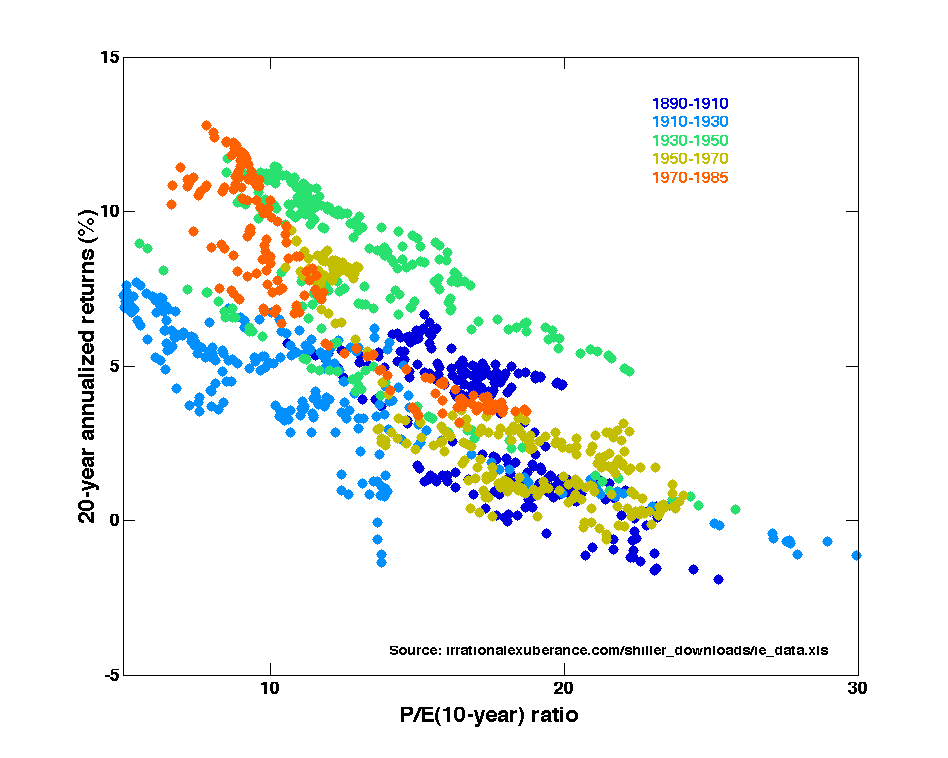
    PE as a Predictor of 20-yr Returns (via Prof Robert Shiller)

    This graph presents the relationship between P/E and 20-yr annualized returns of the S&P 500 (stock market).
    • P/E (Price/Earnings) - The price you pay for each dollar earned/profit 
      • Higher PE = more expensive
      • Lower PE = less expensive
      • Prof Shiller uses an adjusted PE which is the a price paid for the average annual dollars earned over the past 10 years
    •  20-yr Annualized Returns - the average annual return over the next 20 years, after the purchase 
    Irrational ExuberanceProfessor Shiller has separated his data into 5 time periods (20-25 yrs per period).  The graph seems to provide evidence that, purchasing stocks at a lower PE (less expensive) typically results in a higher 20-yr return, than otherwise.  Just as importantly, this relationship between cheaper stocks and higher returns appears to be true for each of the 5 time periods, which covers the period from 1890-1985.

    Where are stocks now?  At today's S&P value of approximately 1200, the 10-yr PE Ratio is currently at 22.  Looking at the graph, evidence indicates that we should perhaps expect 20-yr returns of less than 5% per year if we were to purchase stocks at current prices.  Macro-level indicators such as these are important for making investment decisions because they can often help us set the right expectations about future returns.  They also act as a guiding light during oscillating periods of Fear & Greed, affording us the fortitude to buy when prices are low, and the discipline to differ purchases (or sell) when valuations become frothy.

    Deep Simplicity - Chapter 5

    Earthquakes, Extinctions, and Emergence
    • Complex system are made up of simple components
      • The way component interact is very important (creates complexity)
    • Earthquakes - Richter scale is logarithmic; each unit = factor of 30
      • Follows power-law in frequency-size
        • 10:1 ratio of size-1 to size-2 earthquakes (so on)
        • Power-law is present in fractals (coast of Normandy)
      • Scale-free: no difference b/w small & large earthquake except for size
        • Property of fractals
        • Causes are the same, only difference is magnitude & frequency
      • Ubiquity: Why Catastrophes Happen
    • Throwing rock or frozen potatoes at a wall - scalefree
      • Power-law relationship b/w frequency of large and small fragments
    • Landscape of Moon - created by impacts, which imply meteor impacts are scale-free
    • 1/f Law - size of an even is proportional to 1/(power of frequency f)
      • Soundwaves
        • White noise (completely random) - useless
        • 1/f - provides information
        • Mononote (completely uniform) - useless (ie one single musical note in perpetuity)
    • "Hundred Year Droughts" - can be followed by another "drought", or a "freeze" next year
      • Memory-less
    •  Traffic Jams - frequency and size follow power-law
      • There are jams within jams (fractals)
      • Large jams can be caused by large triggers (crashes) or small triggers (braking)
      • As density of cars increase, lowering the speed limit will decrease traffic
        • Function of time it takes to slow down (less) & speed up (more)
    • Commodity & stock prices follow 1/f & power-law (p.160-161)
      • Relatively unpredictable - small changes in interest rates can have no or much effect
    • Extinctions - KT event refers to extinction of dinosaurs (end of Cretaceous)
      • Big Five - global extinction events in past 600M years
      • Are mass extinctions 'special' or just large versions of small extinctions (scalefree)
      • Jack Sepkoski & David Raup - proved that extinctions occur with 1/f noise
        • Life is a complex system, self-organizing, with energy source, at edge of chaos
    •  Per Bak - Sandpile Model
      • On a tabletop, slowly add grains of sand one at a time (source)
      • Pile slowly forms
      • Avalanche(s) eventually appear (edge of chaos)
      • Sand falls off (sink) - 'equilibrium'
      • Amount of sand stay relatively constant - self-organized criticality
      • Each grain can trigger an avalanche or do nothing
    • Earthquakes: crusts slide against each other, strain builds (like sand), rocks deform, energy may be stored or released, marginally or heavily
    • How Nature Works: The Science of Self-Organized Criticality
    • Sandpile model can be simulated on chess board
      • Randomly stack/drop blocks on squares
      • Once a stack reach 4-high, dispense 1 block to each neighbor
        • Some will eventually begin to fall off the board
      • Creates system at precipice of chaos, with energy source and sink (self-organized)
    • Sand/rice obeys power-law (frequency and size) in avalanches
    • It also displays fractal patterns
    • Use red to denote 'energetic' grains (more chaotic)
      • Initial stages show little red
      • As red grows, density also grows
        • Density determines likelihood of large avalanche
      • Even after large avalanche, not all energy is removed
        • System remains at edge of chaos
    • Stuart Kauffman (Santa Fe Institute) - button analogy
      • Initially unconnected (uncomplex)
      • Use string to randomly connect one button to another randomly (button = node)
      • Each cluster of connected buttons is a network
        • Size of largest cluster network determines complexity of the system
        • Growth of largest cluster is slow at first
        • At approximately (# of buttons)/2, cluster grows exponentially (super cluster)
          • Phase transition
    • Grain/sand connection (thread) - gravity, friction, angles
    • Asteroid connection - Sun, planets, moons, other asteroids
    • Kauffman - developed theory on origin of life describing chemicals engaged in autocatalytic reactions
      • Form network
      • With sufficient connections, life emerges
        • Phase transition
        • Either/or (no ambiguity)
    • Kauffman - DNA cell theory
      • 30K to 100K genes in humans - 256 different kinds of specialized cells
        • Despite every cell having the same DNA
      • With 2 connections per node (DNA)
        • Sqrt(nodes) as number of cycles
        • Sqrt(nodes) as number of steps
      • 1 connection freezes
      • >2 connections lead to chaos (butterfly effect)