
Using logic that can only be described as "asinine", one of the most influential economists in the country, and a member of the Federal Reserve, has just declared that the solution to dangerously high commodity prices is to flood the market with more paper currency...
"If [the rising price of oil] plays through to the broad economy in a way that portends a recession, I would take a position we would respond with more accommodation," Lockhart said at the conference.
Very interesting Mr. Lockhart. So you believe that in a deflationary environment, the proper response is quantitative easing... and you also believe that in a inflationary environment, the proper response is, yet more, quantitative easing... certainly, no one can accuse of you overly-complex thinking.
It is good that educational institutions no longer teach such quaint ideas as the direct positive correlation between money supply and commodity prices. Otherwise, the Federal Reserve would be leading us down the exact opposite of the correct path. It is good...
Maybe after they are violently removed from office by the impoverished lynching mob of lower/middle class, the surviving members of the Federal Reserve could find second careers in carpentry.
Showing posts with label Economy. Show all posts
Showing posts with label Economy. Show all posts

Feb 14, 2011
Plebeian Inflation Report Feb 2011 - Food, Clothing, and Apartment Prices to Rise 10% to 20%
Who should we believe?? Oh yea, rent prices at Post Apartments are being raised approximately 20% for the year 2011. But that's just one data point. Surely, not everyone will raise their rent prices 20%... right?? If so, what will become of the summertime poolside redneck riviera festivals??
Edit: I forgot to include that Kraft & General Mills (and presumably other food manufacturers) plan to raise prices... due to (drum roll) rising food prices... yay!
"Inflation is expected to persist below the levels that Federal Reserve policymakers have judged to be consistent... Overall inflation is still quite low and longer-term inflation expectations have remained stable"
-Ben Bernanke 2/9/2011
"Cotton has more than doubled in price over the past year, hitting all-time highs. The price of other synthetic fabrics has jumped roughly 50 percent as demand for alternatives and blends has risen. Clothing prices are expected to rise about 10 percent in coming months, with the biggest increases coming in the second half of the year...
Mom-and-pop stores are most vulnerable because they have less power to negotiate better prices with suppliers than, say, Wal-Mart Stores Inc... Mary Hutchens, owner of Full of Beans, a 25-year-old children's clothing store in Chevy Chase, Md., worries that price increases could be a death blow. She said she has to discount heavily to stay in business and isn't sure she'll be able to pass along the costs."
-Associated Press 2/14/2011(Thanks for killing small businesses)
Edit: I forgot to include that Kraft & General Mills (and presumably other food manufacturers) plan to raise prices... due to (drum roll) rising food prices... yay!
Jan 13, 2011
Price Control Part One - Commodities Market
http://finance.yahoo.com/news/Govt-moves-to-limit-apf-4112081129.html?x=0&sec=topStories&pos=3&asset=&ccode=
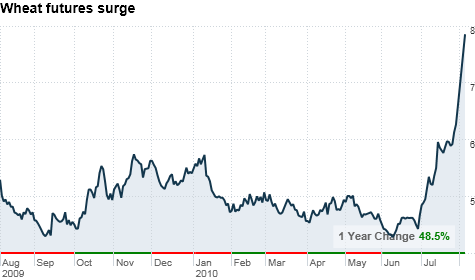
Unsurprisingly, as the government has flooded the market with money, the prices of many commodities (which can't be printed, but must be grown/found) are surging... naturally this surge in prices has been blamed on a faceless culprit, conveniently referred to as "funds, traders, and investors"...
As financial history tells us, these are the same parties culpable for every economic unpleasantry since the dawn of markets, though the real culprits are often the ones who pronounce such accusations through giant microphones (read: politicians)...
And, if the history of every price control ever can teach us anything, its that it never works. We (un)eagerly anticipate the opportunity to share Price Control Part Two (aka, consumer good price control)
Unsurprisingly, as the government has flooded the market with money, the prices of many commodities (which can't be printed, but must be grown/found) are surging... naturally this surge in prices has been blamed on a faceless culprit, conveniently referred to as "funds, traders, and investors"...
As financial history tells us, these are the same parties culpable for every economic unpleasantry since the dawn of markets, though the real culprits are often the ones who pronounce such accusations through giant microphones (read: politicians)...
And, if the history of every price control ever can teach us anything, its that it never works. We (un)eagerly anticipate the opportunity to share Price Control Part Two (aka, consumer good price control)
Jan 5, 2011
Inflation - Who'll ever know?
A growing number of products, from orange juice to toilet paper, are shrinking in size yet being kept at the same price, according to the latest investigation by Consumer Reports.
Happily, Americans are unlikely to notice the hidden 8% inflation (equivalent to paying the same for 59oz vs 64oz OJ), as we will be all too pleased when Angry Bird v5.0 is released. In even better news, this apparent theft will likely be excluded from the government's CPI inflation report... which will likely continue to show that, after excluding rocketing food prices, soaring fuel prices, and corporate theft of individuals (not to mention higher education and healthcare costs), prices paid by Americans likely remained, unsurprisingly, unchanged. Hurray!!
P.S. In real good news, corporate profits are soaring... hahahaa
Happily, Americans are unlikely to notice the hidden 8% inflation (equivalent to paying the same for 59oz vs 64oz OJ), as we will be all too pleased when Angry Bird v5.0 is released. In even better news, this apparent theft will likely be excluded from the government's CPI inflation report... which will likely continue to show that, after excluding rocketing food prices, soaring fuel prices, and corporate theft of individuals (not to mention higher education and healthcare costs), prices paid by Americans likely remained, unsurprisingly, unchanged. Hurray!!


P.S. In real good news, corporate profits are soaring... hahahaa
Sep 10, 2010
Could we have deflation AND inflation??
disclaimer: the following is more logic exercise than economic analysis...
Moot Debate - Misses the Big Picture
Most frequently, the debate around inflation revolves around the all-encompassing metric known as CPI (consumer price index). Today's pundits debate endlessly about the future trajectory of the CPI. However, perhaps speculating what the CPI will be in totality may be missing some important scenarios...
Let us divide goods into two categories and discuss the inflation outlook for each category separately...
The Humble Goods
First, let's talk about the essential commodity goods. Primarily I am thinking of such items as wheat, grain, milk, orange juice, coffee, oil, water, corn, sugar, etc. These are items that most people need to survive, and that are not produced in factories, but must be grown on agricultural land (whether directly or implicity, ie cows eating grass and then producing milk).
 My (unsupported) conjecture is that these goods did not suffer the gluttony of overinvestment/overcapacity during the boom-period. Logically speaking, most people with reasonable living standards do not eat significantly more wheat during boom periods than what's needed to keep them alive. Hence, there's little reason to believe that we developed significantly more farms during the boom period than we needed. Furthermore, most people, with the means to, will continue consuming wheat at a stable pace (sustenance). In fact, global population trends suggest that demand for such commodity goods will continue to increase as populations increase (more grain/wheat) and living standards rise (sugar/milk).
Based upon this line of reasoning, it seems plausible to suggest that such essential commodities are unlikely to experience sustained, long-term price declines. What about price inflation? As central banks around the world work to fight deflation (as measured by simple metrics such as CPI), they will likely increase the monetary base, thereby potentially fueling price inflation in these humbler goods.
Other commodities, such as metals, are more ambiguous. The problem is that steel, concrete, etc are tied to the 2nd group of goods/services more so than wheat/grain. Though we may experience price inflation in food, prices of wood may not increase, because we don't necessarily need more wood to build more houses... more detailed discussion below.
Gold/Silver are unique metals though, since they're value is derived not from industrial use...
The Luxury Goods
 In my opinion, during the boom-years we either produced too many luxury goods (homes) or overinvested in the capacity to produce such goods (ie factories, workers). The extra money that people had which they did not use to buy more wheat was used to buy LCD TV's, ipods, and a nice meal at Applebees. With the decrease in disposable income, consumers will shun these items as they attempt to rebuild household balance sheets, and prepare to retire significantly later than they had originally hoped/anticipated. These are powerful market forces, and will likely lead to irresistible deflationary pressures.
Moot Debate - Misses the Big Picture
Most frequently, the debate around inflation revolves around the all-encompassing metric known as CPI (consumer price index). Today's pundits debate endlessly about the future trajectory of the CPI. However, perhaps speculating what the CPI will be in totality may be missing some important scenarios...
Let us divide goods into two categories and discuss the inflation outlook for each category separately...
The Humble Goods
First, let's talk about the essential commodity goods. Primarily I am thinking of such items as wheat, grain, milk, orange juice, coffee, oil, water, corn, sugar, etc. These are items that most people need to survive, and that are not produced in factories, but must be grown on agricultural land (whether directly or implicity, ie cows eating grass and then producing milk).
 My (unsupported) conjecture is that these goods did not suffer the gluttony of overinvestment/overcapacity during the boom-period. Logically speaking, most people with reasonable living standards do not eat significantly more wheat during boom periods than what's needed to keep them alive. Hence, there's little reason to believe that we developed significantly more farms during the boom period than we needed. Furthermore, most people, with the means to, will continue consuming wheat at a stable pace (sustenance). In fact, global population trends suggest that demand for such commodity goods will continue to increase as populations increase (more grain/wheat) and living standards rise (sugar/milk).
Based upon this line of reasoning, it seems plausible to suggest that such essential commodities are unlikely to experience sustained, long-term price declines. What about price inflation? As central banks around the world work to fight deflation (as measured by simple metrics such as CPI), they will likely increase the monetary base, thereby potentially fueling price inflation in these humbler goods.
Other commodities, such as metals, are more ambiguous. The problem is that steel, concrete, etc are tied to the 2nd group of goods/services more so than wheat/grain. Though we may experience price inflation in food, prices of wood may not increase, because we don't necessarily need more wood to build more houses... more detailed discussion below.
Gold/Silver are unique metals though, since they're value is derived not from industrial use...
The Luxury Goods
It's difficult to exactly define what goods (services) fall in which category, so I'll give some more examples of the type of items I am referring to here: TV's, consumer electronics, housing, auto, mall retailers, casual dining restaurants, computers, and all the various sub-industries that feed off/into the aforementioned. In general, anything that people don't need to directly eat (to survive).
 In my opinion, during the boom-years we either produced too many luxury goods (homes) or overinvested in the capacity to produce such goods (ie factories, workers). The extra money that people had which they did not use to buy more wheat was used to buy LCD TV's, ipods, and a nice meal at Applebees. With the decrease in disposable income, consumers will shun these items as they attempt to rebuild household balance sheets, and prepare to retire significantly later than they had originally hoped/anticipated. These are powerful market forces, and will likely lead to irresistible deflationary pressures.
However, as said before, central banks (and political institutions) need to prevent deflation - economically because of the deathly fear of deflationary spiral, and politically because most export industries (except may Canada, Australia, South Africa, Middle East) rely primarily on luxury goods. They will likely summon a variety of tools to their cause, with the likely outcome of increasing the monetary base. In the aftermath, their policies may very well stop price deflation in these luxury goods, but not without significant price inflation in the humbler goods.
Ramifications
These are too numerous to recount. However, most likely this policy bodes ill for middle-class and lower-class families. With less to spend already due to the recession (depression), they will be devoting a greater portion of their wages to essential goods. With increased price inflation on bread, rice, and water, these families will likely feel further disenfranchised by policy makers, as they find themselves trapped between the proverbial rock and hard place.
In addition, CPI may very well remain flat, or increase moderately for a period. While policy makers cheer the success of their experimentation (make no mistake, that is what it is...), the villagers will be sharpening their pitchforks and pouring kerosene on their torches, as they find themselves struggling more and more just to put food in their mouths...
Though we are few, I am not alone...
Jim Rogers is a big bull for commodities (although he is bullish on metals & industrial commodities too because of China), Michael Burry has also come on record as saying that he is buying 'productive agricultural land with water on site'...
Maybe it's time to buy a tract of land, plant some corn, and learn the banjo...?
Disclaimer - the below graph has cherry-picked data to illustrate my point... I don't believe that the longer-term past is as representative of the near/medium future...

Disclaimer - the below graph has cherry-picked data to illustrate my point... I don't believe that the longer-term past is as representative of the near/medium future...

Sep 8, 2010
Paul Krugman circa 2002
This is an interesting timewarp back to 2002. Then, as now, economists brought to the table 'solutions' to the economic distress the country was facing. Then, as now, Paul Krugman was one of the most clairvoyant, and vocal, voices.
Personally, I think Krugman is incredibly intelligent, and one of the preeminent economists of the current generation. Though I hold tremendous respect for his economic prowess, I don't necessarily share many of his opinions. In this article, Krugman presents his solution of the recession back then...
1) take the medicine, and suffer through the lean years, or
2) create another asset bubble to fuel spending
As we know, the Fed followed Krugman's advice (or agreed with it in practice). In hindsight, Fed policies fueled the housing bubble, which led to roughly 7 subsequent years of gluttony. And now, here we are...
Allow me to propose a heretical idea - Though we can replace a bubble-popped with much hot-air, easy-money, and bubbles-anew, perhaps such a course of action may lead to future discomfort on a grander scale... dare I suggest, it is best not to create replacement asset-bubbles (through government intervention), and to let markets play out as fate/providence/nature desires... perhaps we should grudgingly accept the consequences of capitalism, just as greedily as we embrace the benefits!
Since I'm in a mean mood, check out the OpEd's claim that Greenspan urged Congress to cut taxes to head off the risk of excessive budget surpluses... What the heck does that mean? What is risky about a surplus?? What bizaro-person/institution would consider a surplus risky (implying that a deficit is safe)?
*sigh*
Personally, I think Krugman is incredibly intelligent, and one of the preeminent economists of the current generation. Though I hold tremendous respect for his economic prowess, I don't necessarily share many of his opinions. In this article, Krugman presents his solution of the recession back then...
...the recession of 2001 wasn't a typical postwar slump, brought on when an inflation-fighting Fed raises interest rates and easily ended by a snapback in housing and consumer spending when the Fed brings rates back down again. This was a prewar-style recession, a morning after brought on by irrational exuberance. To fight this recession... Alan Greenspan needs to create a housing bubble to replace the Nasdaq bubble.Pretty clairvoyant no? That's exactly what happened. Why do I admire Krugman? He absolutely nails the situation perfectly! Then, as now, the recession is not the 'typical' post-WW2 recession... this is a post-bubble depression that has only two solutions:
1) take the medicine, and suffer through the lean years, or
2) create another asset bubble to fuel spending
As we know, the Fed followed Krugman's advice (or agreed with it in practice). In hindsight, Fed policies fueled the housing bubble, which led to roughly 7 subsequent years of gluttony. And now, here we are...
Allow me to propose a heretical idea - Though we can replace a bubble-popped with much hot-air, easy-money, and bubbles-anew, perhaps such a course of action may lead to future discomfort on a grander scale... dare I suggest, it is best not to create replacement asset-bubbles (through government intervention), and to let markets play out as fate/providence/nature desires... perhaps we should grudgingly accept the consequences of capitalism, just as greedily as we embrace the benefits!
Since I'm in a mean mood, check out the OpEd's claim that Greenspan urged Congress to cut taxes to head off the risk of excessive budget surpluses... What the heck does that mean? What is risky about a surplus?? What bizaro-person/institution would consider a surplus risky (implying that a deficit is safe)?
*sigh*
Jul 30, 2010
Thoughts on Sugar Highs (aka check ourselves in the mirror)
"No more soda & candy!"
Some combination of that timeless admonition has been around since the discovery of sugar. Children love sugar. It tastes absolutely delightful (our tongues evolved to prefer sweet foods with higher energy, rather than bitter foods with potential poisons)! More importantly, the benefits of sugar (great taste!) were realized immediately, while any potential downsides (if any) were differed until another hour...
Luckily, good parents rarely leave children to their own devices. Being of greater wisdom, parents recognize the longer term consequences of excessive sugar consumption: obesity, cavities, hyperactivity, fatigue (not to mention the extreme long-term consequences: cancer, diabetes, kidney/liver problems, etc). Our parents applied their greater wisdom through methods ranging from the gently paternalistic, to the harshly draconian, in order to influence our behavior with regards to sugar consumption... so that we may live to adulthood, in order to one day pass on these simpler truths to future sugar-fiends...
"No more soda & candy... and money printing!"
Often, when we grow older, we become infect with the condition of 'log in eye'. While we have outgrown our infatuation with sugar, we have merely replaced our old lusts with new addictions... for example, paper wealth! While we busy ourselves with reproving children, we cheer for the sweetness of easy solutions to difficult problems.
 During the recent
 recession depression, the Fed began applying quantitative easing (aka money printing) in order to boost the value of a variety of paper assets, stock markets included. The immediate benefits of this policy are easily visible on the graph to the right... and the correlation is fairly striking!
However, let us curb our enthusiasm, lest we celebrate too soon...
Is quantitative easing the penicillin to all of our economic ailments?
Or is it merely a grown-up version of the now-forgotten sugar-high?
Does not the printing of money have long-term negative consequences?
Is this the free lunch we were all seeking?
Or are we merely children who have rediscovered the time-honored joys of inflation, without the wise-parents of youth to warn us about the potential consequences to follow these short-lived joys?
Parents, and future parents... let us consider carefully the consequences of our own actions. When we were children, we thought, reasoned, and acted as children, but, as has been said, there comes a time when we must put away childish things. Let us forgo the short-lived-sweetness of greed and easy money in favor of the long-lived-savoriness of austerity and prudence!
Some combination of that timeless admonition has been around since the discovery of sugar. Children love sugar. It tastes absolutely delightful (our tongues evolved to prefer sweet foods with higher energy, rather than bitter foods with potential poisons)! More importantly, the benefits of sugar (great taste!) were realized immediately, while any potential downsides (if any) were differed until another hour...
Luckily, good parents rarely leave children to their own devices. Being of greater wisdom, parents recognize the longer term consequences of excessive sugar consumption: obesity, cavities, hyperactivity, fatigue (not to mention the extreme long-term consequences: cancer, diabetes, kidney/liver problems, etc). Our parents applied their greater wisdom through methods ranging from the gently paternalistic, to the harshly draconian, in order to influence our behavior with regards to sugar consumption... so that we may live to adulthood, in order to one day pass on these simpler truths to future sugar-fiends...
"No more soda & candy... and money printing!"
Often, when we grow older, we become infect with the condition of 'log in eye'. While we have outgrown our infatuation with sugar, we have merely replaced our old lusts with new addictions... for example, paper wealth! While we busy ourselves with reproving children, we cheer for the sweetness of easy solutions to difficult problems.
 During the recent
 However, let us curb our enthusiasm, lest we celebrate too soon...
Is quantitative easing the penicillin to all of our economic ailments?
Or is it merely a grown-up version of the now-forgotten sugar-high?
Does not the printing of money have long-term negative consequences?
Is this the free lunch we were all seeking?
Or are we merely children who have rediscovered the time-honored joys of inflation, without the wise-parents of youth to warn us about the potential consequences to follow these short-lived joys?
Parents, and future parents... let us consider carefully the consequences of our own actions. When we were children, we thought, reasoned, and acted as children, but, as has been said, there comes a time when we must put away childish things. Let us forgo the short-lived-sweetness of greed and easy money in favor of the long-lived-savoriness of austerity and prudence!
Jun 20, 2010
Double Dip?
Powerful Predictor of Recessions
This index has been surprisingly powerful at predicting recessions over the past 40 years. Importantly, economist David Rosenberg first pointed out that WLI Growth of negative ten has always indicated a recession occurring or soon to occur (chart below - shaded regions indicate official recessionary periods).
.bmp)
As you can see by this second chart, ECRI WLI growth has declined dramatically to -5.7%. Historically, there has been only one reading at/below -5.7% that did not correspond to a recession.
.bmp)
Based upon this data, it seems more likely than not that the economy will fall back into recession (barring government intervention).
But Wait (before you sell your stocks or jump out the window)...
There are several drawbacks to this conclusion:
- The recent run-up for WLI growth has been the strongest in recorded history. It's possible that the dramatic whiplash back into negative territory is a function of the elasticity of the index (after a strong rise, maybe a strong drop is normal)... and not necessarily ill-boding for the economy
- One study has been done that suggests the ECRI WLI may actually be a lagging indicator of stock performance
- The strong correlation b/w the index and stock performance (suggested in study above) may be due to the fact that stock performance is a component of the index.
Together, these caveats should give considerable pause to the recommendation of preparing for an imminent double-dip for the U.S.
My Opinion (for what it's worth)...
It's hard to say for certain: the evidence is certainly convincing, but a good analyst knows the limitations of the data used. Based upon what I know, I would say the probability of a double-dip recession is approximately 60% (again, barring government intervention such as quantitative easing - aka money debasing). Keep in mind, I would classify myself as a pessimist.
Jun 14, 2010
Trickle Down Economics - Debunked?
Trickle down economics (aka Scraps From the Master's Table), in all its glory. Pictures are worth a thousand words... I'll let my own words be few...


May 18, 2010
Thoughts of/on Interest
Positive View
By influencing the distribution of rewards in society, compound interest selectively confers power on those who are capable of postponing gratification. Compound interest favors people who take the long view (Hardin).
Negative View
Usury is the derivation of profit from biological time, which is linked to life, considered sacred, God-given and divine, leading to excessive worrying about money instead of God, thus subjugating a God-given sanctity of life to man-made artificial notions of material wealth (Wikipedia).
By influencing the distribution of rewards in society, compound interest selectively confers power on those who are capable of postponing gratification. Compound interest favors people who take the long view (Hardin).
Negative View
Usury is the derivation of profit from biological time, which is linked to life, considered sacred, God-given and divine, leading to excessive worrying about money instead of God, thus subjugating a God-given sanctity of life to man-made artificial notions of material wealth (Wikipedia).
May 16, 2010
Living Within Limits - Chapter 8
Growth: Real and Spurious
"Compound interest is the eighth wonder of the world"
-one of the Rothchilds (or Albert Einstein)
Money is Sterile...
To truly fathom the power of compound interest, Hardin offers a lustrous illustration:
Debt is not...
What does grow, is debt. Debt is an abomination that has the power to multiply itself - debt begets more debt. Today, we have a debt-based society. Our money is a form of IOU (debt). All purchases are financed by debt. Our banks happily lend to all willing to borrow. Our government's lifeblood comes from the willingness of others to lend to us.
The prosperity of our society was built upon the backbone of debt. More accurately, the wealth of our society was built upon the belief that debt could be converted into something of value (underlying collateral). However, the flaw, as Hardin points out eloquently, is that 'the convertibility of immaterial debt into material wealth should never be assumed.'
The following list of individuals were against usury (interest) - Plato, Aristotle, Cato, Cicero, Seneca, Plutarch, Aquinas, Muhammad, Moses, Philo, Buddha (from wikipedia, citation needed)
From the King James Bible:
How wealth is created... How resources are made useful to man...
There is one true source of 'wealth' on earth. Consider, 'there is a daily input of wealth from the outside in the form of radiant energy from the sun. Some of this energy is captured by the earth, so terrestrial wealth should steadily increase.'
Inflation, the ultimate tamer of usury...
If usury is to be portrayed in a negative light, then inflation is to be thought of as something virtuous. Hardin gives a general overview, including a historical example of hyperinflation in Rome. However, the key insight that he offers is this: '(we) have never experienced more than the opening stages of (inflation). Our limited experience inclunes us to make light of the danger of truly runaway inflation. The 'normal', slow advance of inflation is dwarfed by rare and explosive outbraks of hyperinflation.' (emphasis added).
Another side of Keynes...
Much has changed since the days of early Christianity. Today, we regard usury as normal, and could scarcely imagine a world without it.
Though most only appreciate one aspect of his genius nowadays, John Maynard Keynes stands out among economists in his view of interest. In his essay, 'Economic Possibilities for Our Grandchildren', he believes that some day we may...

"Compound interest is the eighth wonder of the world"
-one of the Rothchilds (or Albert Einstein)
Money is Sterile...
To truly fathom the power of compound interest, Hardin offers a lustrous illustration:
In Chapter 27 of the book of Matthew we are told that when Judas regretted betraying Jesus for thirty pieces of silver, he brought th emoney ot th echief priests saying, 'I have sinned,' and cast down the pieces of silver as he left the temple. At that poin thte booty became the priests' problem. They decided that since the coins were 'the price of blood' they should not be added to the holy treasury... instead, they took counsel, and bought with them the potter's field, to bury strangers in...
But suppose some rambling Rothschild, or other capitalist, had persuaded the priests that they should 'make their money grow'... Had this happened, Matthew 27 might have been written along the following lines:
'Taking counsel with certain wise men called economists, the priests converted the thirty pieces of silver into gold (presumably the equivalent of 2 grams of gold), which they used to open up an account in the People's Perpetual Gold Bank of Jerusalem, saying "Let this wealth purify itself by quietly drawing interest at 5% per year for two thousand years. Then let both principal and interest be withdrawn from the bank and divided among all the people then living who regret the death of Jesus.'
At 5% compound interest the total sum would, in two thousand years, grow to 4.8E42 grams of gold, roughly 800 trillion earth mass equivalents (Mass of Earth is 5.9E27 grams)Both Aristotle and Martin Luther agree, that 'money is sterile'. This is proven simply, by imagining a gold bullion sitting inside a vault in a bank. Whether after ten years, or 100 years, or 2000 years, the gold will never increase, not one ounce. What would happen if gold could beget itself? Why, then everyone would make a deposit with the People's Perpetual Gold Bank of Jerusalem, in the hopes of getting their 'free lunch'.
Debt is not...
What does grow, is debt. Debt is an abomination that has the power to multiply itself - debt begets more debt. Today, we have a debt-based society. Our money is a form of IOU (debt). All purchases are financed by debt. Our banks happily lend to all willing to borrow. Our government's lifeblood comes from the willingness of others to lend to us.
The prosperity of our society was built upon the backbone of debt. More accurately, the wealth of our society was built upon the belief that debt could be converted into something of value (underlying collateral). However, the flaw, as Hardin points out eloquently, is that 'the convertibility of immaterial debt into material wealth should never be assumed.'
There are two sorts of wealth-getting: one is a part of household management, the other is retail trade. The former is necessary and honorable, while that which consists in exchange is justly censored; for it is unnatural, and a mode by which men gain from one another. The most hated sort, and with the greatest reason, is usury, which makes a gain out of money itself, not from the natural object of it. For money was intended to be used in exchange, but not to increase at interest. This term 'interest', which means the birth of money from money, is applied to the breeding of money because the offspring resembles the parent. Of all modes of getting wealth this is the most unnatural. -Aristotle
It is monstrous and unnatural that an unfruitful thing should breed, that a thing specifically sterile, such as money, should bear fruit and multiply of itself -OresmeUsury...
The following list of individuals were against usury (interest) - Plato, Aristotle, Cato, Cicero, Seneca, Plutarch, Aquinas, Muhammad, Moses, Philo, Buddha (from wikipedia, citation needed)
From the King James Bible:
[Exodus 22:25] If thou lend money to any of my people that is poor by thee, thou shalt not be to him as an usurer, neither shalt thou lay upon him usury.
[Leviticus 25:36] Take thou no usury of him, or increase: but fear thy God; that thy brother may live with thee.
[Leviticus 25:37] Thou shalt not give him thy money upon usury, nor lend him thy victuals for increase.
[Deuteronomy 23:19] Thou shalt not lend upon usury to thy brother; usury of money, usury of victuals, usury of any thing that is lent upon usury:
[Deuteronomy 23:20] Unto a stranger thou mayest lend upon usury; but unto thy brother thou shalt not lend upon usury: that the LORD thy God may bless thee in all that thou settest thine hand to in the land whither thou goest to possess it. ("and who is my brother")Historically, there are many well-respected opponents of charging interest. Biblically speaking, usury is hardly portrayed as commendable... something clearly banned in order to preserve the well-being of one's own community, but accepted when applied to strangers, and those in other tribes. Certainly, not as bad as murder or adultery (universally condemned), but nevertheless, its the kind of (bad) behavior best saved for those not in one's own immediate family. (Muslims ban it outright)
- Take already existing, but diffusely distributed materials, and bring them together into higher, useful, concentrations (iron, copper, etc.)
- Energy released from accumulations (coal, oil, etc.)
- Reducing the amount of human effort required for a certain task (lever)
- Reducing amount of time spent to perform a task (wheel)
There is one true source of 'wealth' on earth. Consider, 'there is a daily input of wealth from the outside in the form of radiant energy from the sun. Some of this energy is captured by the earth, so terrestrial wealth should steadily increase.'
Inflation, the ultimate tamer of usury...
If usury is to be portrayed in a negative light, then inflation is to be thought of as something virtuous. Hardin gives a general overview, including a historical example of hyperinflation in Rome. However, the key insight that he offers is this: '(we) have never experienced more than the opening stages of (inflation). Our limited experience inclunes us to make light of the danger of truly runaway inflation. The 'normal', slow advance of inflation is dwarfed by rare and explosive outbraks of hyperinflation.' (emphasis added).
Another side of Keynes...
Much has changed since the days of early Christianity. Today, we regard usury as normal, and could scarcely imagine a world without it.
Though most only appreciate one aspect of his genius nowadays, John Maynard Keynes stands out among economists in his view of interest. In his essay, 'Economic Possibilities for Our Grandchildren', he believes that some day we may...
Approximately, half of the 'another hundred years' have passed. Keynes would likely be rolling in his grave, if he knew about his 'intellectual' descendants (forgive me Sir John, that's their names for themselves. I would never insult you in such a way)....return to some of the most sure and certain principles of religion and traditional virtue - that avarice is a vice, that the exaction of usury is a misdemeanour , and the love of money is detestable... But beware! The time for all this is not yet. For at least another hundred years we must pretend to ourselves and to every one that fair is foul and foul is fair; for foul is useful and fair is not. Avarice and usury and precaution must be our gods for a little longer still.
Subscribe to:
Posts (Atom)