May 13, 2011

Omnivore's Dilemma - Introduction Notes


Introduction - National Eating Disorder

“Many people today seem perfectly content eating at the end of an industrial food chain, without a thought in the world; this book is probably not for them.”

In American culture, inherited cultural knowledge about eating has been replaced by confusion & anxiety.  This important activity now requires remarkable amount of expert help.  Lipophobia in 1970’s has morphed into Carbophobia in 2000’s, causing bread & pasta, a staple of dining tables, to be replaced with imperfect substitutes.  This was caused by media storm of diet books, studies, and magazine articles (including the formerly discredited Dr. Atkins).  Such a violent change in a culture’s eating habits, unseen in other countries in Europe & Asia, is the sign of a national eating disorder - other signs include dietary goals in the shape of a pyramid set by government legislation, endless stream of diet books (every January), confusion of dietary supplements for meals, obsession with fast food, and gross obesity.  Americans are dismayed at the fitness of other countries, despite what appears to be lavish consumption.  Others are amazed that Americans are so confused about what to eat.

Omnivore’s dilemma was first mentioned by Rousseau and Brillat-Savarin, addressing the boon and burden of being able to eat with greater freedom (and risk).  Some anthropologists believe our brains evolved in order to better address omnivore’s dilemma.  In addition to our senses, culture memory serves important function in distinction between good & bad foods - stores accumulated wisdom of countless human experiences.  Culture acts to avoid dilemma at the onset of every meal.  Part of American problem stems from plethora of choices available at local markets (Note - America is unique in this aspect; most cultures only have access to locally grown fruits & vegetables).  America also suffers from heterogenous culture.  Lack of steadying culture of food leaves us susceptible to some profiteers and marketers, who view omnivore’s dilemma as an opportunity.  It is in food industry’s interests to exacerbate our anxieties regarding diet, to better assuage us with new products.

Purpose of this book is to trace the origin of meals in order to discover the most fundamental relationships between species in nature, vis a vis eaters & eaten.  It focuses on three separate food chains that sustain us:  1) industrial, 2) organic, and 3) hunter-gatherer.  

Ecology also tells us that all life in on earth is a competition for energy, specifically solar energy (Note: Living Within Limits - Garrett Hardin).  Industrial revolution of food chain has changed fundamental rules of the game.  Reliance on sun has been replaced with reliance on petrol-fuels.  This has greatly increased the among of food energy available.  Abundance seems to have deepened the Dilemma, not render it obsolete.

The end result is the discovery of the Perfect Meal, not because of its taste, but because of the labor and thought-intensive process, enjoyed in the company of other foragers.  It provides the rare opportunity to eat in full consciousness of everything involved in the food we eat - it involves paying the full karmic price of a meal.  Industrial eating removes us from the relationship we have with nature’s other inhabitants - we often disregard not only the animal’s pain, but our pleasure.

The book will also illustrate the tension between nature and human industry.  Often, our prodigiousness comes into conflict with nature’s ways, particularly when we try to maximize efficiency (vast monocultures, fossil fuels, artificial animal farms, novel diets).

“But in the end this is a book about the pleasures of eating, the kinds of pleasure that are only deepened by knowing.”

Apr 11, 2011

Crawford & Company CRD-A/B Arbitrage

The stock market is one of the few places where two nearly identical goods are bought and sold for vastly different prices.  Consider the example of Crawford & Company, an insurance services provider based in Atlanta, GA.

Crawford has two classes of stock, Class A (CRD.A) and Class B (CRD.B).  The two classes share identical economic interests and similar liquidity profiles.  However, the Class A shares have no voting rights, while the Class B shares have votes, and thereby should command a premium.  How much of a premium?  According to currently quoted prices, B shares are currently 43% more expensive than A shares ($4.60 vs $3.20)!!

The biggest risk for potential arbitrageurs are

  1. the possibility of this price discrepancy further expanding 
  2. the timeliness of the convergence.

As the below graph shows, the current B-share premium of 43% is high by historical standards.  However, the premium exploded during the financial crisis - the possibility of Risk 1 clearly rises during periods of acute financial distress.  Interestingly, the spread pre-crisis ranged from 0-20%, while post-crisis, the spread has shifted upwards to a new range of 20-40%.

Mar 14, 2011

Only in America...

Mammon demands sacrifice I guess... no more commentary necessary

http://www.liveleak.com/view?i=696_1300116168

Mar 7, 2011

Problem: High Oil Prices... Solution: Print More Money!?!?!?

Using logic that can only be described as "asinine", one of the most influential economists in the country, and a member of the Federal Reserve, has just declared that the solution to dangerously high commodity prices is to flood the market with more paper currency...

"If [the rising price of oil] plays through to the broad economy in a way that portends a recession, I would take a position we would respond with more accommodation," Lockhart said at the conference.

Very interesting Mr. Lockhart.  So you believe that in a deflationary environment, the proper response is quantitative easing... and you also believe that in a inflationary environment, the proper response is, yet more, quantitative easing... certainly, no one can accuse of you overly-complex thinking.

It is good that educational institutions no longer teach such quaint ideas as the direct positive correlation between money supply and commodity prices.  Otherwise, the Federal Reserve would be leading us down the exact opposite of the correct path.  It is good...

Maybe after they are violently removed from office by the impoverished lynching mob of lower/middle class, the surviving members of the Federal Reserve could find second careers in carpentry.

Feb 17, 2011

Article - Is Wealth Gap Widening Under Obamananke? (yes!)

Article is sorta fluffy, but it conveniently sums up many of the arguments against the policies we are currently engaged in...
Consumer sentiment among families with income above $75,000 jumped to 88.2 in early February, the highest since under President Bush in 2007, according to the Reuters/University of Michigan's latest survey. 
But sentiment among lower-income households dropped to 67.7 from 72.1 in January, trapped in a range it's been stuck in since just after Obama's 2009 inauguration. 
The president helped widen this gap by compromising on the Bush tax cuts with the Republicans in Congress, agreeing at the end of last year to extend them on all incomes for two years, investors said. 
Meanwhile, Fed Chairman Ben Bernanke has set upon a large quantitative easing program that has boosted the stock market by increasing liquidity, but also raised the costs of basic goods that hit the poor the very hardest.

Feb 16, 2011

Poverty 1 - Middle Class 0

'Better late than never' - that's what I suspect the motto of mainstream media is.  Oh well.  Here's today's soundbite...
Are you better off than your parents? 
Probably not if you're in the middle class. 
Incomes for 90% of Americans have been stuck in neutral, and it's not just because of the Great Recession. Middle-class incomes have been stagnant for at least a generation, while the wealthiest tier has surged ahead at lighting speed. 
In 1988, the income of an average American taxpayer was $33,400, adjusted for inflation. Fast forward 20 years, and not much had changed: The average income was still just $33,000 in 2008, according to IRS data. 
Meanwhile, the richest 1% of Americans -- those making $380,000 or more -- have seen their incomes grow 33% over the last 20 years, leaving average Americans in the dust. Experts point to some of the usual suspects -- like technology and globalization -- to explain the widening gap between the haves and have-nots 
And public policy of the past few decades has only encouraged the trend. 
The 1980s was a period of anti-regulation, presided over by President Reagan, who loosened rules governing banks and thrifts. 
A major game changer came during the Clinton era, when barriers between commercial and investment banks, enacted during the post-Depression era, were removed. 
In 2000, President Bush also weakened the government's oversight of complex securities, allowing financial innovations to take off, creating unprecedented amounts of wealth both for the overall economy, and for those directly involved in the financial sector. 
Tax cuts enacted during the Bush administration and extended under Obama were also a major windfall for the nation's richest. 
And as then-Federal Reserve chairman Alan Greenspan brought interest rates down to new lows during the decade, the housing market experienced explosive growth. 
"We were all drinking the Kool-aid, Greenspan was tending bar, Bernanke and the academic establishment were supplying the liquor," Deutsche Bank managing director Ajay Kapur wrote in a research report in 2009. 
But the story didn't end well. Eventually, it all came crashing down, resulting in the worst economic slump since the Great Depression. 
With the unemployment rate still excessively high and the real estate market showing few signs of rebounding, the American middle class is still reeling from the effects of the Great Recession.
Meanwhile, as corporate profits come roaring back and the stock market charges ahead, the wealthiest people continue to eclipse their middle-class counterparts. 
"I think it's a terrible dilemma, because what we're obviously heading toward is some kind of class warfare," Johnson said.
(emphasis added)

Feb 15, 2011

Public Utilities - Electricity, Water, Sewage... Vampire Squids?

In recently declassified testimony (why is this crap classified anyways??) given back in November 2009, Mssr. Bernanke had this response when asked about his thoughts on new financial reform...
I just want to say this as strongly as possible -- the reform will be a failure if we could not contemplate the failure of Goldman Sachs. That is, there needs to be a system by which Goldman Sachs will go bankrupt and Goldman Sachs’ creditors could lose money. If we don’t have that, then we might as well treat them as a utility, because that’s what they are.

Feb 14, 2011

Plebeian Inflation Report Feb 2011 - Food, Clothing, and Apartment Prices to Rise 10% to 20%

Who should we believe??  Oh yea, rent prices at Post Apartments are being raised approximately 20% for the year 2011.  But that's just one data point.  Surely, not everyone will raise their rent prices 20%... right??  If so, what will become of the summertime poolside redneck riviera festivals??
"Inflation is expected to persist below the levels that Federal Reserve policymakers have judged to be consistent... Overall inflation is still quite low and longer-term inflation expectations have remained stable" 
-Ben Bernanke 2/9/2011 
"Cotton has more than doubled in price over the past year, hitting all-time highs. The price of other synthetic fabrics has jumped roughly 50 percent as demand for alternatives and blends has risen. Clothing prices are expected to rise about 10 percent in coming months, with the biggest increases coming in the second half of the year... 
Mom-and-pop stores are most vulnerable because they have less power to negotiate better prices with suppliers than, say, Wal-Mart Stores Inc... Mary Hutchens, owner of Full of Beans, a 25-year-old children's clothing store in Chevy Chase, Md., worries that price increases could be a death blow. She said she has to discount heavily to stay in business and isn't sure she'll be able to pass along the costs."
-Associated Press 2/14/2011 
(Thanks for killing small businesses)

Edit:  I forgot to include that Kraft & General Mills (and presumably other food manufacturers) plan to raise prices... due to (drum roll) rising food prices... yay!

Feb 10, 2011

Detecting Asset Bubbles Before the POP

"...the Fed cannot reliably identify bubbles in asset prices"
Chairman Ben Bernanke, 2002

Some interesting commentary today from Google's CEO Eric Schmidt, which appears to reveal that there are people with 1) more clairvoyance than Mr. Bernanke or 2) more undeserved arrogance... history will tell us who is right (again, 1)
There are clear signs of a new Internet bubble in corporate valuations, Google's chief executive Eric Schmidt said in an interview with a Swiss magazine on Thursday.
Asked about the high valuations being put on companies such as social network company Facebook and game developer Zynga, Schmidt said in an interview with Bilanz: "There are clear signs of a bubble ... But valuations are what they are. People believe that these companies will achieve huge sales in the future."
The Wall Street Journal reported on Thursday that Google, Facebook and others have held low-level takeover talks with Twitter, valuing the company as high as $10 billion.

Jan 19, 2011

America's Myth of Social (Im)mobility

At the risk of being a jerk, this post is not for the graph-reading-challenged... (I'm too lazy to explain it)

Exhibit A - Belief of Social Mobility (America)


Jan 13, 2011

Price Control Part One - Commodities Market

http://finance.yahoo.com/news/Govt-moves-to-limit-apf-4112081129.html?x=0&sec=topStories&pos=3&asset=&ccode=

Unsurprisingly, as the government has flooded the market with money, the prices of many commodities (which can't be printed, but must be grown/found) are surging... naturally this surge in prices has been blamed on a faceless culprit, conveniently referred to as "funds, traders, and investors"...

As financial history tells us, these are the same parties culpable for every economic unpleasantry since the dawn of markets, though the real culprits are often the ones who pronounce such accusations through giant microphones (read: politicians)...

And, if the history of every price control ever can teach us anything, its that it never works.  We (un)eagerly anticipate the opportunity to share Price Control Part Two (aka, consumer good price control)

Jan 5, 2011

Inflation - Who'll ever know?

A growing number of products, from orange juice to toilet paper, are shrinking in size yet being kept at the same price, according to the latest investigation by Consumer Reports.

Happily, Americans are unlikely to notice the hidden 8% inflation (equivalent to paying the same for 59oz vs 64oz OJ), as we will be all too pleased when Angry Bird v5.0 is released.  In even better news, this apparent theft will likely be excluded from the government's CPI inflation report... which will likely continue to show that, after excluding rocketing food prices, soaring fuel prices, and corporate theft of individuals (not to mention higher education and healthcare costs), prices paid by Americans likely remained, unsurprisingly, unchanged.  Hurray!!

P.S. In real good news, corporate profits are soaring... hahahaa

Dec 27, 2010

Visual Evidence of Evolution in Technological Specimens

The first of these phones is from circa 1995 AD.  The latest version shown here is from 2008 AD.  Ironically, these pictures were taken via my latest phone (2010 AD), which now contains a 7 megapixel camera, at roughly 1/3 the width of the big black box shown on the far left.

If I had (originally bought) the fossilized remains of the specimens, I would also be able to show the similar extinction pattern of a variety of other species:

  • Ipod
  • Radio
  • Camcorder
  • GPS
  • Alarmclock
  • Phone
  • Ukulele tuner
  • Gameboy
  • Flashlight
  • Compass


The only thing that I now have is the Droid X...


Dec 21, 2010

Biology (Campbell) - Chapter 1

Principles of Biology

1) Emergent properties - living world has hierarchical structure, from molecules to biosphere.  Novel properties emerge as a result of interactions at lower levels.

2) Cell - basic unit of structure & function.  Prokaryotic (simple) and Eukaryotic (complex).

3) Heritable information - life relies on inheritance of information via DNA molecules.  Each DNA strand contains nucleotides (alphabet), which string together to form gene sequences

4) Structure & Function - form and function are correlated at all levels

5) Interaction with environment - organisms are open systems that exchange material & energy with surroundings

6) Regulation - feeback mechanisms regulate hemeostasis of organism to create relatively steady state - positive feedback is rare in nature

7) Unity & Diversity - wide range of horizontal organisms, but many/all organisms share similar traits

8) Evolution - key explanation of unity and diversity; differential reproduction via natural selection

9) Scientific Inquiry - observation, question, hypothesis, prediction, test

10) Science, Tech, Society - relationship of science and tech to society is critical

Dec 14, 2010

Safety & Sanity - Sacrifices at the Alter of Capitalism

Inflammatory headings notwithstanding...

More and more, I am of the belief that capitalism, though a system that has contributed immensely to the welfare of human beings (on average), is deeply flawed.  And the blemishes are unsightly enough, that society should think twice, thrice or however many times necessary, before we trust and hope that untethered free markets will be able to deliver us from the more unsavory aspects of human society that have plagued us since... forever (ie poverty, inequality, injustice, starvation, war, etc etc)...

Let me give you a perfect example of how twisted capitalism can be.  In our stock market, there are instruments (securities) that are created in order to facilitate the buying & selling of shares of our country's various economic enterprises (read, companies).  In addition, there are other economic instruments created to bring liquidity to various markets, for example the commodities market.  The key is this...

Whenever there is a need for a product, the market will create it... if we want more stock, prices will go up, companies will sell stock and prices will reach equilibrium... if we want more bonds, prices will go up, companies will sell bonds and prices will reach equilibrium... if we wanted more interest-rate-swaps... coffee-futures... etc etc

However, there is a major flaw in that statement.  The market does not create based on need.  The market creates based upon WANT.

Let me give you an example.  I will not name the specific security, but recently I found a prospectus for a newly created product, which now trades on the stock market.  Let me offer you some carefully selected excerpts from the prospectus of this product (a prospectus should tell you the characteristics and risks of a financial product... kinda like a nutrition label on food products)...
In almost any potential scenario the Closing Indicative Value (as defined below) of (product) is likely to be close to zero after 20 years...
The long term expected value of (produt) is zero.  If you hold your (product) as a long term investment, it is likely that you will lose all or a substantial portion of your investment.
I didn't make that up.  This product was created.  It is structured in such a way, that the 'long term expected value' is ZERO.  And people buy it.  If this instrument was sold in grocery stores, it would have a surgeon general's warning.  This is an instrument that nobody should need.  It kills people('s wealth).  But, it was created because there was a demand for such a product.  People wanted another instrument to make bets with, even if it's a terrible one.  Thank you capitalism.

(To be fair, it's not capitalism that's messed up... it's the participants.  Then again, to be fair, the same could be said for communism or any other -ism)

Nov 2, 2010

War on Poverty... Skirmishes with Wealth

Give me neither poverty nor riches; feed me with the food that is needful for me, lest I be full and deny you and say, “Who is the Lord?” or lest I be poor and steal and profane the name of my God. 
Proverbs 30:8-9
Just started reading Robinson Crusoe.  In the very beginning, Crusoe recounts the advice his father gave him... that to be poor is to be exposed to the miseries, hardships, labours, and sufferings of life, while to be rich is to be embarrassed by pride, luxury, ambition, and envy.  Both beggar and king, for different reasons, wish for sustenance that is sufficient, but no more and no less.

Sep 25, 2010

Charlier Munger Q&A Transcript - U of Michigan 2010

Recently, Charlie Munger made himself available for an extended Q&A at the University of Michigan Law School.  Below is my transcript of the talk.  The video can be found here.

BQ - Becky Quick
CM - Charlie Munger
Munger Speech - U of Michigan 2010

Sep 11, 2010

The Consummate Saint (as defined by the Greeks)

In Plato's The Republic (Penguin Classics), Glaucon, in an attempt to define morality, describes what he believes to be the consummate moral person...
...And at his side let us place the just man in his nobleness and simplicity, wishing, as Aeschylus says, to be and not to seem good. There must be no seeming, for if he seem to be just he will be honoured and rewarded, and then we shall not know whether he is just for the sake of justice or for the sake of honours and rewards; therefore, let him be clothed in justice only, and have no other covering; and he must be imagined in a state of life the opposite of the former. Let him be the best of men, and let him be thought the worst; then he will have been put to the proof; and we shall see whether he will be affected by the fear of infamy and its consequences. And let him continue thus to the hour of death; being just and seeming to be unjust... (Book 2 - Challenge to Socrates)
The most honored of men, his glory is hidden by human eyes.  Thus, the highest must seem as the lowest, until the day of his death.  Thus, 'so that his morality can be tested'.

In my opinion, by these philosophical standards, Jesus was the person being described.  Unlike most, Jesus pursued genuine obedience & love (goodness), rather than the image of it.  Stripped of this aura (lest he pursue his reputation and honor instead of something higher), he was instead slandered and believed to be a heretical menace.  With a 'colossal reputation for immorality' (by association), he faithfully followed this path that was decided for him, as all lambs must, until his ignoble death.

Interestingly enough, the consummate devil is one who is evil at heart, but has all the appearances of being the most righteous/honorable man... (food for thought)

Sep 10, 2010

Could we have deflation AND inflation??

disclaimer: the following is more logic exercise than economic analysis...


Moot Debate - Misses the Big Picture

Most frequently, the debate around inflation revolves around the all-encompassing metric known as CPI (consumer price index).  Today's pundits debate endlessly about the future trajectory of the CPI.  However, perhaps speculating what the CPI will be in totality may be missing some important scenarios...

Let us divide goods into two categories and discuss the inflation outlook for each category separately...

The Humble Goods

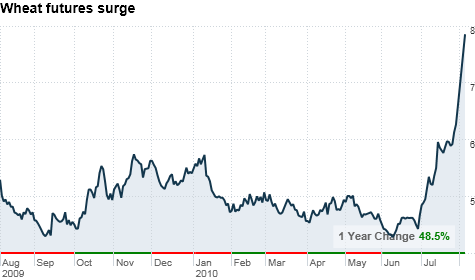
First, let's talk about the essential commodity goods.  Primarily I am thinking of such items as wheat, grain, milk, orange juice, coffee, oil, water, corn, sugar, etc.  These are items that most people need to survive, and that are not produced in factories, but must be grown on agricultural land (whether directly or implicity, ie cows eating grass and then producing milk).

My (unsupported) conjecture is that these goods did not suffer the gluttony of overinvestment/overcapacity during the boom-period.  Logically speaking, most people with reasonable living standards do not eat significantly more wheat during boom periods than what's needed to keep them alive.  Hence, there's little reason to believe that we developed significantly more farms during the boom period than we needed.  Furthermore, most people, with the means to, will continue consuming wheat at a stable pace (sustenance).  In fact, global population trends suggest that demand for such commodity goods will continue to increase as populations increase (more grain/wheat) and living standards rise (sugar/milk).

Based upon this line of reasoning, it seems plausible to suggest that such essential commodities are unlikely to experience sustained, long-term price declines.  What about price inflation?  As central banks around the world work to fight deflation (as measured by simple metrics such as CPI), they will likely increase the monetary base, thereby potentially fueling price inflation in these humbler goods.

Other commodities, such as metals, are more ambiguous.  The problem is that steel, concrete, etc are tied to the 2nd group of goods/services more so than wheat/grain.  Though we may experience price inflation in food, prices of wood may not increase, because we don't necessarily need more wood to build more houses... more detailed discussion below.


Gold/Silver are unique metals though, since they're value is derived not from industrial use...


The Luxury Goods

It's difficult to exactly define what goods (services) fall in which category, so I'll give some more examples of the type of items I am referring to here:  TV's, consumer electronics, housing, auto, mall retailers, casual dining restaurants, computers, and all the various sub-industries that feed off/into the aforementioned.  In general, anything that people don't need to directly eat (to survive).

In my opinion, during the boom-years we either produced too many luxury goods (homes) or overinvested in the capacity to produce such goods (ie factories, workers).  The extra money that people had which they did not use to buy more wheat was used to buy LCD TV's, ipods, and a nice meal at Applebees.  With the decrease in disposable income, consumers will shun these items as they attempt to rebuild household balance sheets, and prepare to retire significantly later than they had originally hoped/anticipated.  These are powerful market forces, and will likely lead to irresistible deflationary pressures.

However, as said before, central banks (and political institutions) need to prevent deflation - economically because of the deathly fear of deflationary spiral, and politically because most export industries (except may Canada, Australia, South Africa, Middle East) rely primarily on luxury goods.  They will likely summon a variety of tools to their cause, with the likely outcome of increasing the monetary base.  In the aftermath, their policies may very well stop price deflation in these luxury goods, but not without significant price inflation in the humbler goods.

Ramifications

These are too numerous to recount.  However, most likely this policy bodes ill for middle-class and lower-class families.  With less to spend already due to the recession (depression), they will be devoting a greater portion of their wages to essential goods.  With increased price inflation on bread, rice, and water, these families will likely feel further disenfranchised by policy makers, as they find themselves trapped between the proverbial rock and hard place.

In addition, CPI may very well remain flat, or increase moderately for a period.  While policy makers cheer the success of their experimentation (make no mistake, that is what it is...), the villagers will be sharpening their pitchforks and pouring kerosene on their torches, as they find themselves struggling more and more just to put food in their mouths...

Though we are few, I am not alone...

Jim Rogers is a big bull for commodities (although he is bullish on metals & industrial commodities too because of China), Michael Burry has also come on record as saying that he is buying 'productive agricultural land with water on site'...

Maybe it's time to buy a tract of land, plant some corn, and learn the banjo...?

Disclaimer - the below graph has cherry-picked data to illustrate my point... I don't believe that the longer-term past is as representative of the near/medium future...


Sep 8, 2010

Paul Krugman circa 2002

This is an interesting timewarp back to 2002.  Then, as now, economists brought to the table 'solutions' to the economic distress the country was facing.  Then, as now, Paul Krugman was one of the most clairvoyant, and vocal, voices.

Personally, I think Krugman is incredibly intelligent, and one of the preeminent economists of the current generation.  Though I hold tremendous respect for his economic prowess, I don't necessarily share many of his opinions.  In this article, Krugman presents his solution of the recession back then...
...the recession of 2001 wasn't a typical postwar slump, brought on when an inflation-fighting Fed raises interest rates and easily ended by a snapback in housing and consumer spending when the Fed brings rates back down again. This was a prewar-style recession, a morning after brought on by irrational exuberance. To fight this recession... Alan Greenspan needs to create a housing bubble to replace the Nasdaq bubble.
Pretty clairvoyant no?  That's exactly what happened.  Why do I admire Krugman?  He absolutely nails the situation perfectly!  Then, as now, the recession is not the 'typical' post-WW2 recession... this is a post-bubble depression that has only two solutions:

1) take the medicine, and suffer through the lean years, or
2) create another asset bubble to fuel spending

As we know, the Fed followed Krugman's advice (or agreed with it in practice).  In hindsight, Fed policies fueled the housing bubble, which led to roughly 7 subsequent years of gluttony.  And now, here we are...

Allow me to propose a heretical idea - Though we can replace a bubble-popped with much hot-air, easy-money, and bubbles-anew, perhaps such a course of action may lead to future discomfort on a grander scale... dare I suggest, it is best not to create replacement asset-bubbles (through government intervention), and to let markets play out as fate/providence/nature desires... perhaps we should grudgingly accept the consequences of capitalism, just as greedily as we embrace the benefits!

Since I'm in a mean mood, check out the OpEd's claim that Greenspan urged Congress to cut taxes to head off the risk of excessive budget surpluses...  What the heck does that mean?  What is risky about a surplus??  What bizaro-person/institution would consider a surplus risky (implying that a deficit is safe)?

*sigh*